

Nicholas Crafts
Before classPrepare, explore and arrive with a point of view
1.1
WHY THIS MATTERS
Invention is not diffusion.
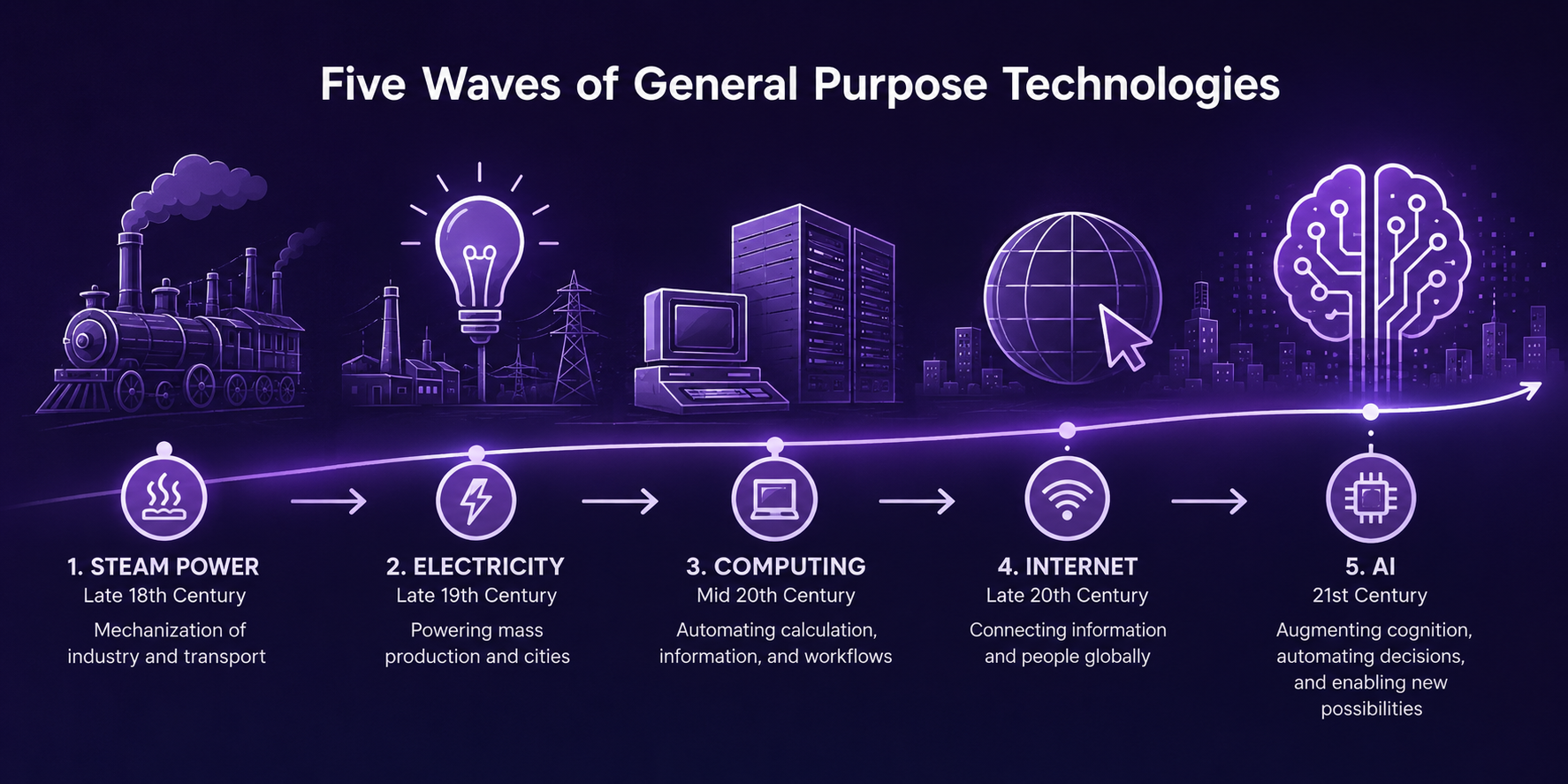
Transformational technologies frequently look economically disappointing in their early stages. Electrification required factories to reorganize. Computers demanded complementary investment in software, skills and business processes.
AI may meet the same constraints. The question is how rapidly firms, workers and institutions reorganize around it. Yet software can diffuse faster than physical technologies. Is this time structurally different?
General-Purpose TechnologySolow Productivity ParadoxDiffusionComplementary InvestmentOrganizational ChangeInnovator’s DilemmaRegulationProductivity Lag
1.2
BEFORE CLASS
Read. Watch. Arrive curious.
Required reading
James Freeman
Robots Have Been About to Take All the Jobs for 100 Years ↗
Wall Street Journal · Feb. 24, 2026Optional deep dive
Baily, Byrne, Kane and Soto
Generative AI at the Crossroads: Light Bulb, Dynamo, or Microscope? ↗
Federal Reserve Board · 2025Mark Wynne and Lillian Derr
Advances in AI will boost productivity, living standards over time ↗
Federal Reserve Bank of Dallas · June 24, 2025Charles Jones
AI and our Economic Future ↗
NBER Working Paper · Jan. 16, 20261.3 PREWORK SUBMISSION
Prepare an example and consider the additional questions in Brightspace.
Submit your responses before class.
Diffusion Detective + Session 1 questions
INTERACTIVE EXERCISE
How fast does technology really diffuse?
Estimate the years from invention to roughly 50% adoption among relevant users. Complete all six estimates, review them, and submit once.
YOUR ESTIMATE
1 of 6No name or login is required.During classSlides + Zoom
1.4
Class Session Links
After class follow-upConsolidate, submit and reflect
1.5 · AFTER CLASS